The first thing that hits you when the hat goes on is the quiet. Not silence. The regulator still carries the hiss of air and the inevitable inhale and exhale of each breath, but a kind of pressure-quiet the rest of the world never gets. I don’t know how to explain it, except that it is almost as if the ocean is talking to you, in a way that is unbelievably relaxing and nerve-racking at the same time. One minute you are standing on a steel deck in the middle of the Gulf of Mexico, thinking about the task at hand while the sun hammers you and the tenders. The next, you are descending the downline, dropping through the water like a rock until you hit bottom and reach the work site. Ohio to Houston I did not grow up in these waters, nor did I ever think I would grow up to become a commercial diver. I came from Ohio, a state rich in farmland, not oceanic coast. About twenty days after I graduated from Margaretta High School in Castalia, I packed what I had and moved to Houston. That was the whole plan: get to Texas, get into dive school, and get in the water. It sounded easy. Well, you know what they say. I enrolled at The Ocean Corporation. The tanks. The chamber. The welding bays. The zero-visibility drills. The long days that are supposed to feel like the job before the job ever starts. Ocean Corp has been turning out commercial divers since 1969. I was just another kid on the roster trying not to wash out. About ten percent of an incoming class lasts until the end. We started with thirty-four eager students. The numbers dwindled quickly. By the end we had a class of ten, one of the larger graduating groups. After dive school, only about one percent of a class typically lasts the first year in the field. I believe that out of my class, only two of us are still diving, including myself. Eight short months and perfect attendance later, I hired on with Epic Divers and Marine as an eighteen-year-old in Harvey, Louisiana. Eighteen That is the part people always stop on. Eighteen. Fresh out of school. A Louisiana diving company putting a kid on the deck and, soon enough, in the water. Epic did not take me the first time I interviewed, probably the age, and the fact that it was my first real job. It took about a month. I kept calling the operations manager and leaving voicemails. Finally he answered, and I told him I was ready to work, that I had an apartment in Harvey five minutes away, and that I could start tomorrow. It actually worked. The squeaky wheel gets the grease. The next day, it all started. Epic was a Gulf outfit then, based in Harvey: a full-service commercial diving and marine-support company, the kind that lives on platform work, pipelines, inspections, and whatever the field throws at you next. I was not a veteran. I was a red-hat tender, a rookie, who wanted the dive hat and the water time. You Do Not Get the Hat First You get the deck. You learn the gear until you can assemble it half-asleep. You figure-eight and tend the umbilical. You flake the jet hose. You work the hydraulics up and down. You give the infamous repeat-back to the supervisor: retrieval line on bottom. You run the chamber and try not to bend anyone. You fetch coffee. You listen. You learn like a sponge. The Gulf is a hard and hot teacher. Visibility is trash sometimes. The weather turns. Schedules do not exist in any way a regular person would recognize. You work twelve-hour shifts, seven days a week when you are out. You lose track of the calendar. Days become weeks. Weeks become months. Before you know it, you have spent two hundred seventy days or more offshore. There are no windows on a lot of the dive-support vessels. You might get woken at 2 a.m. or 2 p.m. The industry wants someone in the water around the clock, or whenever it is most convenient for the job. As I said before, nine out of ten people who go through dive school do not last a year. That is not a scare line. That is the number. The ones who stay are the ones who can laugh through the stupidity of the day, stay useful when they are exhausted, and not let the job break them. “It’s not how you start. It’s how you finish.” A very wise man once told me that. It stuck in my head on my first hitch offshore, when I was ready to quit because I sucked so badly and the work was long and hard. You have to be a jack-of-all-trades and still do one thing perfectly, or several things perfectly, when it counts, and get shit done. And when you are not perfect, and I mean perfect, you get an earful of how stupid and shitty you are as a diver. But the next dive is like a new day. Redemption. There is an old saying in this trade: you are only as good as your last dive. I try to live by that saying in everything I do now. What the Work Actually Is People always ask what a commercial diver actually does. The short answer is whatever the oil field needs done that a machine still cannot do reliably. Platform inspections. Pipeline repairs. Burning steel underwater with an exothermic torch that throws ten-thousand-degree heat and hydrogen gas in water that can explode on you if it is not vented correctly. Cutting. Cleaning. Installing. Inspecting. Abandoning. Some days you are a mechanic. Some days you are a rigger. Some days you are just the person they send down because something broke at one hundred eighty feet and the clock is running on a vessel that costs tens of thousands of dollars a day to sit there. Most days in the Gulf you work by feel. Zero visibility. Your hands become your eyes. You count bolts by touch. You burn a straight line by drag and feel. You know when the current is trying to walk you off the structure because your umbilical starts to pull the wrong way. You learn the jacket legs and the layout, the HDs and VDs, the clamp, the flange, the cut. You learn that the tender on the other end of the hose is not a helper. He is the reason you come back up. Money, Risk, and Coming Home The money can be good when the work is there: overtime, depth pay, long hitches. It can stack up quickly. It can also disappear when a weather window closes or a project gets delayed or canceled. You live with that uncertainty. You live with the knowledge that the job is inherently dangerous, and that the people who talk the most about danger are usually the ones who have not been in it long enough. The veterans talk about procedures, about the man on the hose, about not getting sloppy on the last dive of a long hitch, or about how they got really fucked up at a diver bar once and probably started a fight or two. Coming home is its own kind of shock after a long hitch. You step off the boat in Fourchon or Houma, drive toward the city, and the world is suddenly loud again. Heat. Food. Traffic. People who have no idea what a decompression table is. The contrast is almost funny. One week you are living in a steel box with the same crew, eating the same meals, thinking in depths and bottom time. The next you are sitting at a table onshore and someone is talking about the weather like it is an inconvenience instead of a work stoppage. I do not romanticize it. The job takes pieces of you if you let it. Relationships onshore have to survive long stretches of absence. Your body keeps a ledger: joints, ears, the way cold water never quite leaves your bones. You learn to respect the tables and the chamber because the bends do not care that you were eighteen when they first put you to work. The Part I Keep But there is something down there I have never found anywhere else. When the work is going right and the hat is quiet and your hands know the steel, the rest of it falls away. No crowd. No noise from the city. Just the job, the air in the hose, and the knowledge that the only person who can finish this particular piece of work is you. That is the part I keep. Not the danger stories. Not the paycheck. The part where an Ohio kid who moved to Houston twenty days after graduation ends up thirty or a hundred and eighty feet down off Louisiana and then reaches the surface again, with the work done and the hat still in good hands. For a little while, that is enough. Make sure to follow Patrick Harkness on X

I watched K-State last 2 games here is what they do well. Kansas State is 2-0 under first-year head coach Collin Klein after a 71-3 opener against Nicholls and a 34-7 win over Washington State. The offense has been productive and physical, averaging 52.5 points and 523 yards per game. Dominant rushing attack: This has been the clearest strength. The Wildcats have rushed for 607 yards on 84 carries (7.2 yards per carry) with 7 rushing touchdowns. • Rodney Fields Jr. (Oklahoma State transfer) leads the way: 206 yards and 2 TDs, including a 75-yard scoring run to open the second half against Washington State. He also had 101 yards and a score in the opener. • Depth behind him is real. Joe Jackson, Jay Harris, and Monterrio Elston Jr. have all scored rushing TDs. Avery Johnson himself has 101 rushing yards and a score. • They generated 312 rushing yards vs. Nicholls and 295 vs. Washington State (7.4 ypc in that game). Six different players scored on the ground against Nicholls. The offensive line has created consistent push and lanes. Klein noted after Week 1 that the first-team unit had no missed assignments and kept Johnson clean. Efficient, complementary passing Avery Johnson has been accurate and productive: 37-of-55 (67.3%), 391 yards, 6 passing TDs, and 2 interceptions. He added a rushing TD in the opener. The two picks were really bad, stared down the WR and the CB Jaylen Thomas for Wash State jumped the route and picked him off twice (1-TD). • Against Nicholls he was 15-of-21 for 199 yards and 3 TDs before coming out early. • Against Washington State he was 22-of-34 for 192 yards and 3 TDs (plus 78 rushing yards). The two interceptions were the main blemish; one was returned for Washington State’s only score. • Josh Manning (Missouri transfer) has emerged as the top target: 13 catches, 130 yards, 2 TDs. He had a career-high 10 receptions for 97 yards and a score against Washington State and has been reliable on third downs with good YAC. Joe Jackson has also been a dual-threat weapon (receiving TDs in both games). Efficiency and scheme: • Third-down conversion: 19-of-27 (70%) through two games. • They’ve been balanced and physical rather than one-dimensional. Klein’s offense emphasizes run game and play-action, with Johnson comfortable in the pocket when protected. • Time of possession and first-down production have been strong (58 first downs in two games). Context: Both opponents have been limited. Nicholls is FCS and Washington State’s offense has been poor (166 total yards against K-State). The Wildcats still have some finishing issues Johnson himself pointed out after the Washington State game, they left points on the field and didn’t always put the opponent away as cleanly as they wanted. The rushing game, offensive line, and Johnson-to-Manning connection look like the things that have traveled well through two weeks. Those will be the areas Tulane has to slow down this Saturday in Manhattan. #RollWave Make sure to follow Patrick Harkness on X

It means Kadin Semonza is no longer the backup who waited. He is the quarterback who won the game. Saturday was his first start at Tulane after transferring from Ball State in January 2025, sitting behind Jake Retzlaff last year, then losing the August camp battle to Zeon Chriss-Gremillion. He came in at halftime of the Duke loss. Five days later Will Hall named him the starter. Against South Alabama he went the distance, 14-of-22 for 212 yards, one touchdown, zero picks and the throw that decided a 28-24 win. That last ball is the whole story. Down three with 1:22 left, third down at the South Alabama 14, the play was a run read. Semonza saw the look, threw it anyway, and dropped a back-shoulder fade to Destyn Hill in the corner. Hill held it. 28-24, 1:17 left. Defense gets the stop. Victory formation. That is not a caretaker quarterback. That is a starter taking the play off-script because the game asked for it. Hall’s postgame line was the endorsement: “Yeah, he’s a quarterback, man.” What changed for him: He had already proven he could produce. MAC Freshman of the Year at Ball State in 2024: 2,904 yards, 25 touchdowns. What he had not proven in New Orleans was that he could close. Saturday he did it on the first chance he was given for four quarters. The winning drive was clean: option pitch to Jaylin Lucas, 13 yards to Garrett Mmahat on third-and-1, 36 yards down the sideline to his brother Cash, then the fade to Hill. Three-for-three, 63 yards, no panic. Pocket presence was better than it was at Duke. The ball came out on time. He did not hunt hero ball until the play actually required it. That matters because the job was never just about arm talent. Hall needed someone who would not flinch after a 17-3 opener and a midweek quarterback change. Semonza’s own words after getting the start were that he prepares like a starter because he knows in his heart that is what he is. The South Alabama tape is the first public proof. Kansas State is next: The offense still lived on explosives instead of chains. Thirteen first downs is not a starter’s weekly standard. The defense is a problem he cannot throw his way out of every week. AIE: He stayed, practiced, took the half at Duke, and then made the throw when Hall handed him the keys. That path, waiting, then delivering is now part of how this staff will talk about him. The real takeaway: For Semonza, this win is identity. Not “the guy who replaced Zeon.” The guy who took a run call and threw the winner anyway. Long, hard journey, first start, first win of the Will Hall era, local receivers and a 214-yard back making it possible and the quarterback finishing it. That is what he has been chasing since Mission Viejo. Saturday he finally got to play the last snap as the starter, and the last snap was the one that counted. #RollWave Make sure to follow Patrick Harkness on X

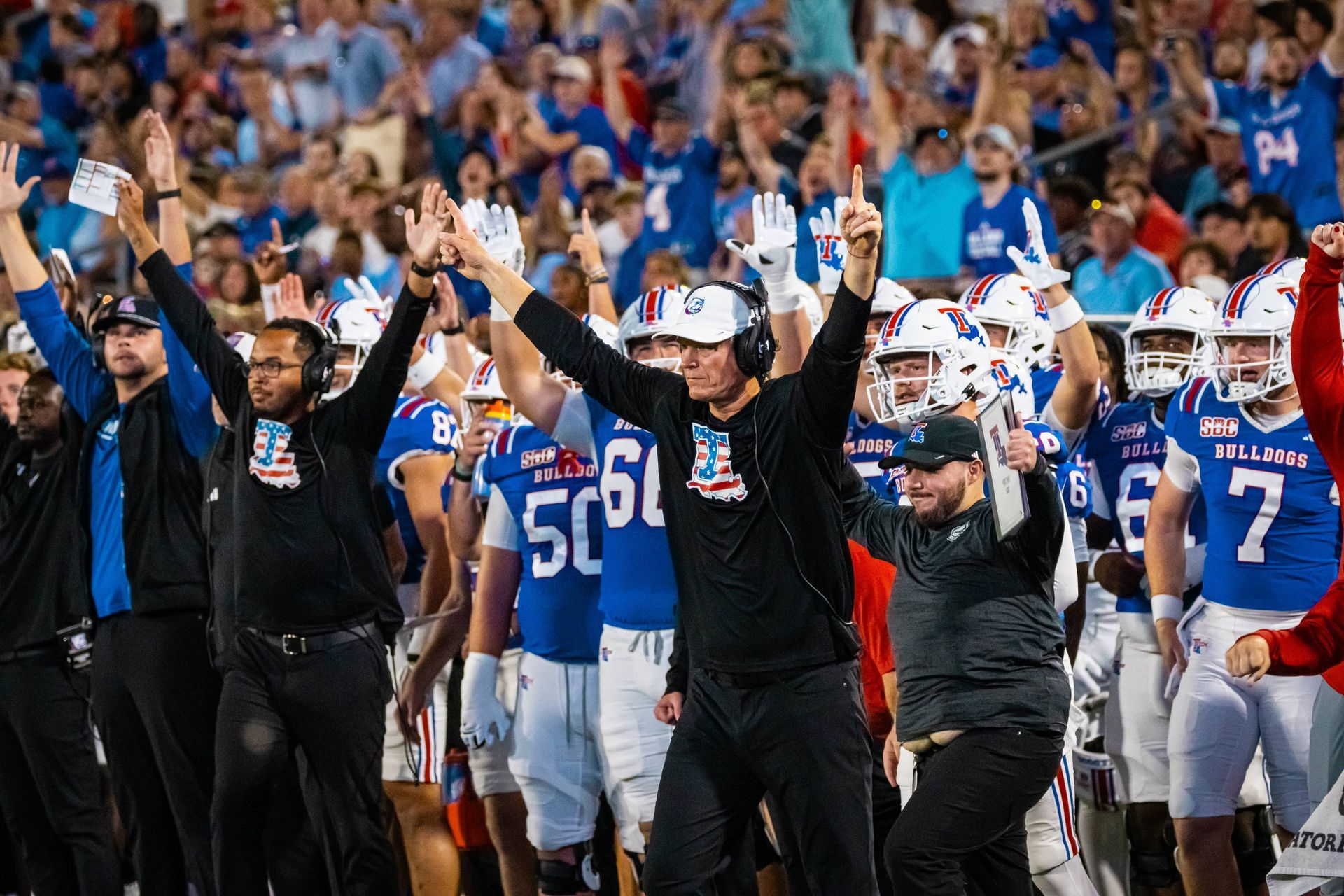
It was a tale of two halves and a story of two sides of the football. While the defense picked up where they left off against Clemson a week ago and put on another dominant performance, things did not go as smoothly for the offense. The first half was littered with mistakes, sloppiness, and overall poor play. While the LSU offense faltered, turning the ball over four times in the first half, the defense picked them up. Louisiana Tech had 0 total yards at halftime, along with -20 rushing yards. That marks the second week in a row in which they’ve held their opponent to negative rushing yards in a half. Sam Leavitt made quite a few mistakes, but he owned up to them. He said after the game that he was trying to do too much and was attempting to put the team on his back following some red zone inefficiency. To his credit, he cleaned it up in the second half and went back to work. All in all, it may seem strange to nitpick a 31-point win. We watched almost the same exact game a year ago when the Bulldogs came to Tiger Stadium in week 2 of the 2025 season. Brian Kelly’s team stumbled to a 23-7 victory, but was also very ugly. The positive news is that while the Tigers played equally ugly in this one, they’re improved enough where an ugly win leads to a 45-14 score. Game Flow For the second straight week, LSU got the ball first and failed to get anything going. A quick 3-and-out forced a Grant Chadwick punt for LA Tech’s first possession. As they did a week ago, Blake Baker’s defense forced a 3-and-out of their own, capped off with Deuce Geralds’s first sack of his career. Sam Leavitt used both his arm and legs on the ensuing drive with multiple gains of 17 yards, including a strike to Winnie Watkins and a scramble down in to the red zone. The drive stalled, though, leading to a Scott Starzyk 29-yard field goal to give LSU a 3-0 lead. A quick 3-and-out would get the ball right back to the Tigers and that’s where they found their first explosive play of the night. Leavitt hit Jackson Harris for a huge gain of 42 yards to get the ball down to the LA Tech 2 yard line. Two plays later, he used his legs and LSU jumped out to a 10-0 lead. TJ Dottery initiated what would be the first of two forced fumbles, giving his team great field position at the Bulldogs 41 yard line, but it did not amount to anything. Every offensive possession in the 2 nd quarter resulted in a 3-and-out for LA Tech with the exception of time expiring going in to halftime. LSU gave them plenty of opportunities, though, because it was a nightmare of a quarter for Lane Kiffin’s offense. First, it was a Eugene Wilson III fumble after a nice catch and run, followed by Leavitt’s first interception on an overthrow to Trey’Dez Green. The offensive production had halted for the Tigers, but that was starting to turn around after the back-to-back turnovers. Leavitt had completions of 15, 24, and 15 yards to Green as LSU drove right down the field to set up a 1 st and goal from the 2 yard line. Consecutive plays of -2 yards set up a 3 rd and goal from the 6 and that’s when the entire first half got flipped on it’s head. Leavitt threw a quick slant to Harris, but Jordan McRae picked it off and took it back 100 yards for a return touchdown and what looked to be a 17-0 lead for LSU, quickly turned in to a 10-7 head scratcher. Once again, Kiffin’s offense came right back out and started marching down the field with big completions to Harris and Green. Coming out of a timeout with 39 seconds left in the half and facing a 3 rd and 8 at LA Tech’s 14 yard line, Leavitt threw his third interception of the quarter and Tiger Stadium had become frustrated. Sounds of soft groans and a few boos rained down as the teams went to the locker room. The Bulldogs came out and went 3-and-out for the sixth time, followed by a shanked punt that set LSU up with more great starting field position. Dilin Jones finally broke free after a rough first half of 10 carries for 3 yards. He busted a 46-yard run to get down to the LA Tech 2 yard line. Unfortunately, the redzone issues persisted. The next three plays went for -1, 0, and -8 yards and the Tigers had to settle for a 25-yard Starzyk field goal to make it 13-7. At the 9:34 mark of the 3 rd quarter, LA Tech finally got their 1 st first down thanks to a DJ Pickett pass interference. Two plays later, they got another one on a Princewill Umanmielen roughing the passer. LSU would eventually force a 4 th and 5 conversion attempt that was a deep shot over Dashawn Spears’s head, but he recovered and broke it up to get the ball back to the Tigers. Needing to get some rhythm, LSU quickly found themselves behind the chains thanks to a false start and another negative Jones rush. But, as he did all night, Trey’Dez Green stepped up and made a 23-yard reception. Three plays later, Leavitt bounced outside to green grass on a designed QB run for his second rushing touchdown of the night to give the Tigers some breathing room. A two-point conversion made it 21-7. Spears’s good night continued on the next drive as he blasted Blake Baker coming off of the edge, forcing a floated pass right in to the waiting arms of Pickett. LSU, again, had to settle for a Starzyk field goal for a 24-7 lead. Following another Bulldog 3-and-out, Charlie Weis Jr dialed up a new wrinkle that had yet to be seen. On a 3 rd and 1, he lined up Green in the backfield for a direct snap to get the conversion. The very next play showed Leavitt’s improvisation skills on full display, as he scrambled to his right and bought just enough time to point for Wilson III to go deep. The Florida transfer made an incredible over the shoulder catch for a 53-yard gain, which led to Leavitt’s third rushing touchdown of the night on the next play. It was 31-7 and LSU fans were finally feeling better, although it took much longer than anticipated. LA Tech responded with their first self-generated first down of the night, but two players later, freshman Deuce Geralds added to his incredible performance by ripping the ball out of Jalen Mickens’s hands as he was being held up by Ty Benefield. The recovery and return by Jhase Thomas set the Tigers up with an immediate redzone possession at the 20 yard line and just when it looked like they were set to stall out, again, Leavitt hit Green for his first touchdown catch of the season to make it a 38-7 game. With the reserves coming in on defense for Blake Baker, they stumbled, once again. Mickens caught a ball up the seam and shot out of a canon for a 67-yard touchdown. That makes for back-to-back weeks that the 2’s and 3’s caved late in the game. After the teams traded a few punts, Landen Clark entered the game and showed a nice rappoire with Tyree Holoway. The two connected for passes of 21 and 16 yards, followed by a 7-yard touchdown run by Clark to finish off the scoring and make it a 45-14 game and that would be the final score. Conclusion While far from pretty, the ultimate goal is to stay healthy and win the game. LSU did both of those things and now sits at 2-0 with a massive game on the way. The Tigers will hit the road for the first time in 2026 for the game everyone around the country has been waiting for since last November. It’s LSU vs Ole Miss for Lane Kiffin’s return to Oxford. The Rebels are off to a 2-0 start of their own, following a last-minute victory in week 1 over Louisville and a thrashing of Charlotte this week. The Tigers are currently -2.5 point favorites, but will have to play much cleaner football as they head to an extremely hostile environment. Full preview for the game will be coming later this week, so stay tuned in here at The Kneaux!

Well what a wild game. The game was certainly there for the taking and I’m sure the team will look back and see all the missed opportunities they failed to capitalize on. The first half was, how would I put it, leaving a lot to be desired on offense. However the defense on the other hand did their job to keep the game close as long as they did. The missed fumble call could have been the difference in this one but that’s easy to say with hindsight. I’ll be curious if the league reviews and comments on that specific call this week. The slow start on offense though looked like the culmination of starters not playing at all during the preseason and still being rusty. Kellen Moore had an even slower start to the season last year with much more sloppy play but this felt very avoidable had the strategy been different in the preseason. Even so the Saints were only down seven at the half which felt like a miracle given the circumstance. The second half was where it all changed for the Saints. But not until the slow start on offense continued into the start of the third quarter where the Lions were finally able to capitalize on the Saints mistakes to take a twenty one point lead. You couldn’t fault the defense at that point because of the spot they were repeatedly put in because of the offense. But with their backs against the wall the offense finally shook off the rust and got to work. Shough and company stormed back to tie the game in the fourth quarter as the offense quickly down the field multiple times finishing drives in the end zone. The defense was the unsung hero in the comeback attempt as they kept the Lions offense off the field and only allowing one field goal in the fourth quarter. The Saints had a chance to win the game at the end of regulation but the 62 yard field goal attempt was missed by Carlson. Onto overtime. In overtime the Lions answered first with a touchdown to St Brown which would force the Saints to respond in turn. The Saints answered with a touchdown of their own before deciding to play for the win instead of a potential tie situation. They failed on the two point conversion to fall to the Lions 31-30 in overtime. The two point conversion was right call by Kellen Moore and company in my eyes. The Saints had the momentum almost the whole second half, were playing on the road in a game where they were down multiple scores while also knowing the rest of the division had already lost. So no harm done if they didn’t convert, they’d have the same record as everyone else if it didn’t work. It was the right type of aggression you like to see as a fan even if the end result wasn’t what you wanted. Overall I thought this game was going to be a good litmus test for the Saints and after the first half I would have said they failed the test. But the second half showed me what the team is capable of moving forward. They hung tough and made plays when they needed to and almost came back against a really good Lions team who have been playoff contenders the past few years. So although they didn’t get the win the Saints passed the litmus test in my eyes. If the Saints can consistently play like they did in the second half moving forward there’s no telling what their ceiling could be this year.